From BMW to Bureaucracy: How Toilet Access Exposes Inequality and Poverty
Before reading further, take 30 seconds to count: * How many toilets/bathrooms are in your house? * How many people live
Before reading further, take 30 seconds to count: * How many toilets/bathrooms are in your house? * How many people live

Ask any IBDP Economics teacher, and they'll tell you that mastering supply and demand curves and the AD/
In the IB Economics course, the difference between a good essay and an excellent one often lies not in what

As you prepare for your IB Economics assessments, it's valuable to explore concepts that can help you demonstrate higher-level analytical skills. While not officially included in the IB Economics course guide diagrams, the Kuznets Curve offers an excellent framework for strengthening your Assessment Objective 3 (AO3) skills - synthesis and evaluation.
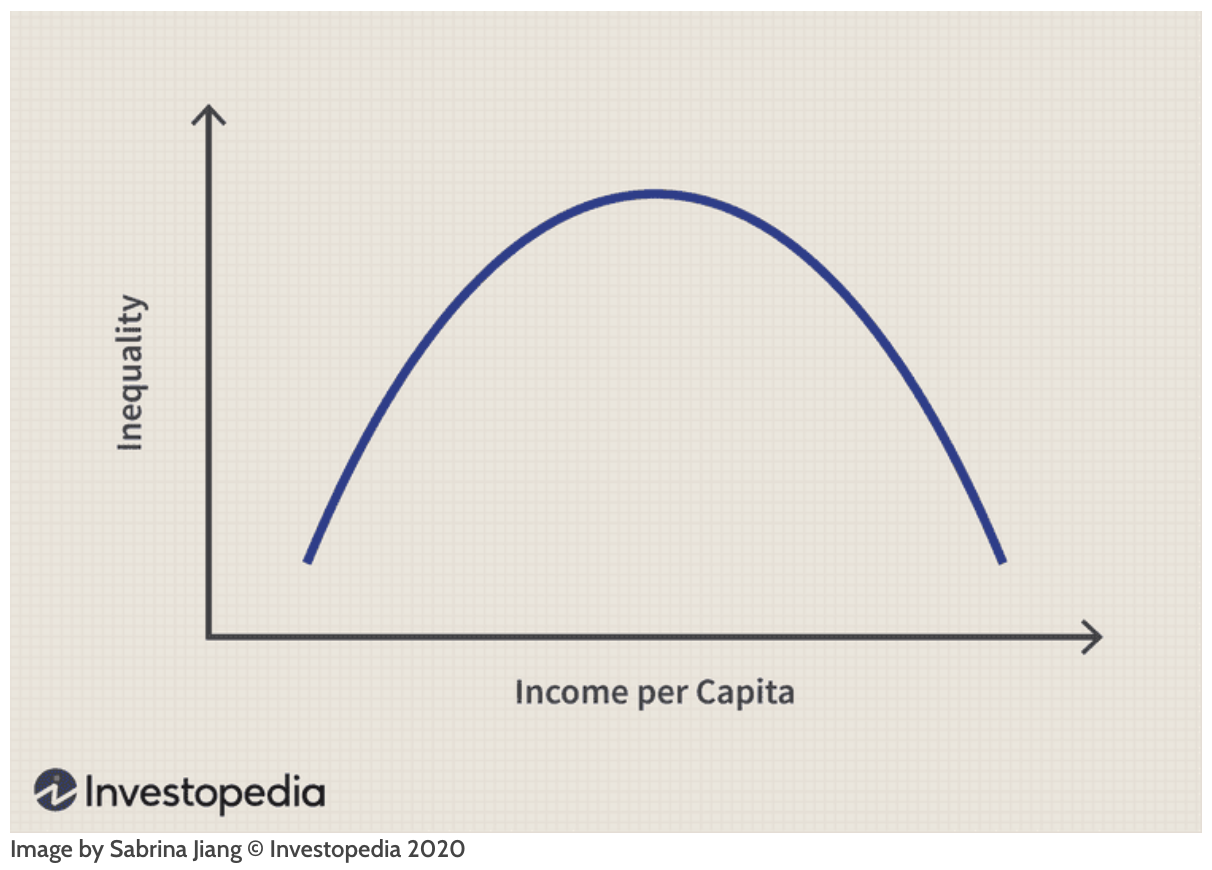
Originally proposed by economist Simon Kuznets in the 1950s, the Kuznets Curve represents the hypothesis that as an economy develops, market forces first increase then eventually decrease economic inequality. This creates an inverted U-shaped relationship between economic development (measured by GDP per capita) and inequality.
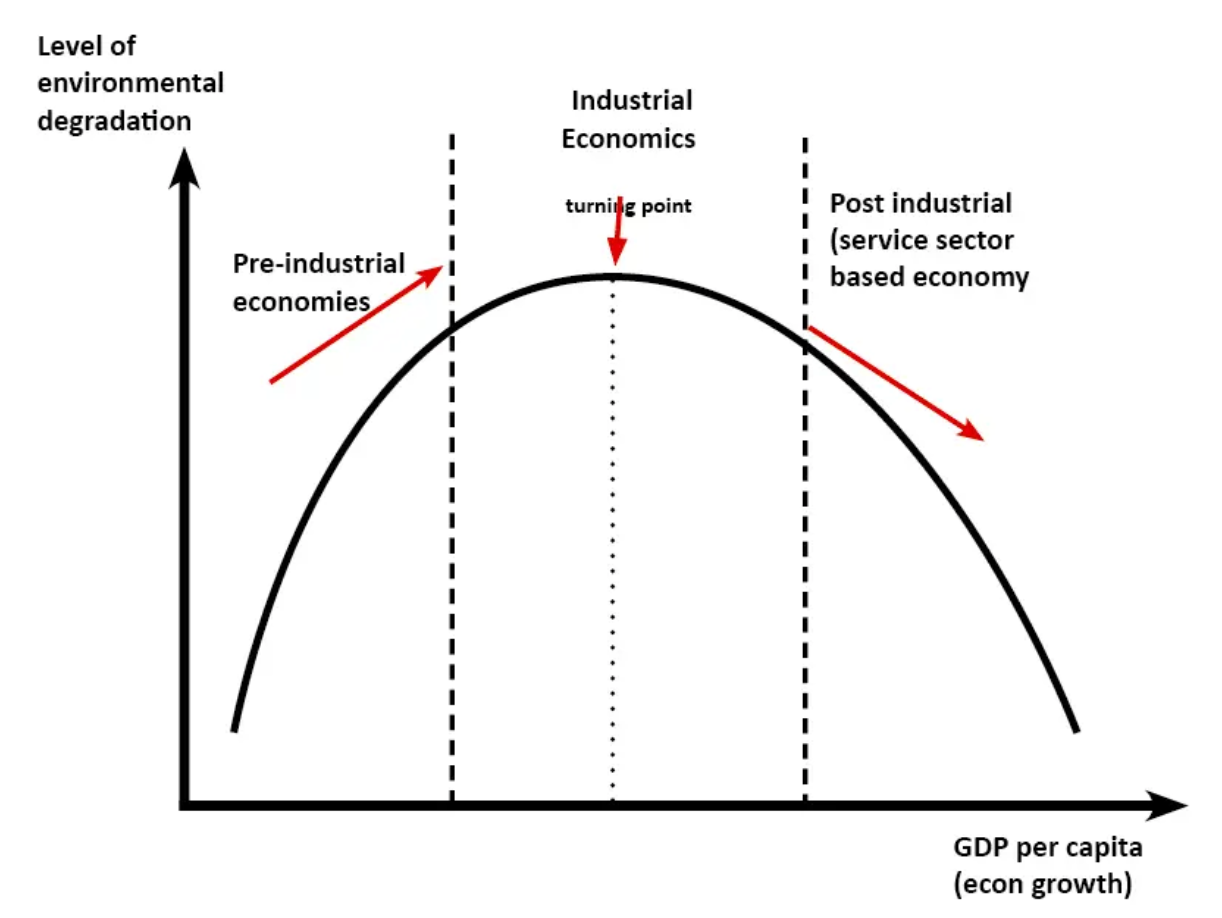
In recent decades, this concept has been extended to environmental concerns, creating the Environmental Kuznets Curve (EKC), which suggests that environmental degradation follows a similar pattern: increasing in the early stages of economic growth, then decreasing after a certain income threshold as societies prioritise environmental quality.
One of the most powerful aspects of the Kuznets Curve for developing your evaluation skills is its explicit incorporation of time. In economics, a classic evaluation approach is to distinguish between short-term and long-term effects, and the Kuznets Curve embodies this distinction.
When you analyse economic issues through the Kuznets framework, you automatically consider:
This temporal dimension allows you to construct more sophisticated evaluations that recognise how economic relationships change over time, rather than presenting static analyses.
Section 2.8 of the IB Economics syllabus explores market failure due to externalities and common pool resources. The Environmental Kuznets Curve (EKC) provides an excellent analytical framework for this topic.
When discussing negative externalities of production and consumption, you can use the EKC to analyse:
Consider addressing questions like: "To what extent is environmental degradation an inevitable consequence of economic growth?" or "Evaluate the effectiveness of different policy approaches in helping countries avoid the peak of the Environmental Kuznets Curve."

Section 3.4 focuses on the economics of inequality and poverty, making it an ideal place to apply the original Kuznets Curve to strengthen your evaluation skills.
When analysing inequality, consider:
To demonstrate strong evaluation skills, address questions such as: "To what extent is economic inequality a necessary step in development?" or "Evaluate the claim that inequality will naturally decline as economies mature."
The Environmental Kuznets Curve aligns perfectly with Section 4.7 on sustainable development, particularly for higher-level (HL) students exploring the relationship between sustainability and poverty.
You can enhance your synthesis skills by:
For strong AO3 development, explore questions like: "Examine the claim that environmental protection is a luxury good that only wealthy countries can afford" or "To what extent does economic growth eventually lead to environmental improvement?"
Sections 4.9 and 4.10 address barriers to economic development and strategies to promote growth and development. The Kuznets framework provides an excellent lens for evaluating different approaches.
In your analysis, consider:
A particular strength of the Environmental Kuznets Curve is how it connects microeconomic concepts of market failure with broader global economic issues. This integration helps you demonstrate your ability to link different parts of the syllabus:
The IB Economics assessment objectives expect you to move from knowledge to application to synthesis and evaluation. Here's how you can use the Kuznets Curve to develop these higher-order skills:
The Kuznets Curve encourages you to question economic orthodoxy. Is growth always beneficial? Does development necessarily follow predictable patterns? By examining these questions, you develop the ability to uncover hidden assumptions in economic theories.
The curve provides a framework around which you can build nuanced arguments. Rather than simplistic claims about growth being "good" or "bad," you can construct arguments that acknowledge the complex trade-offs involved in development.
For your essays, try formulating responses to questions like: "Using the Environmental Kuznets Curve, construct an argument for why developing nations should or should not be held to the same environmental standards as developed nations."
The Kuznets Curve is particularly valuable because it's controversial. Empirical evidence sometimes supports it and sometimes contradicts it. This ambiguity creates perfect conditions for showcasing your evaluation skills.
In your research, gather data on several countries' Gini coefficients and environmental indicators over time, evaluating whether they follow the predicted Kuznets pattern.
For HL students, the Kuznets framework provides an excellent structure for policy recommendations. You can analyse where a country sits on the curve and recommend appropriate policies to either accelerate or alter its trajectory.
Practice responding to prompts like: "Recommend policies that could help a middle-income country avoid the peak of the Environmental Kuznets Curve, supporting your answer with economic theory."
For microeconomic policy analysis, try: "Evaluate the effectiveness of different market-based approaches (carbon taxes, tradable permits) versus command-and-control regulation in addressing the environmental externalities represented by the Environmental Kuznets Curve."
What makes the Kuznets Curve so valuable for developing your AO3 skills is that it invites critique. Unlike simpler economic models, the Kuznets Curve represents a hypothesis about long-term development patterns that cannot be easily proven or disproven.
By engaging with this framework, you can:
These are exactly the higher-order thinking skills that examiners look for in top-scoring responses. By moving beyond the question of whether the Kuznets Curve is "right" or "wrong" to analysing its implications and limitations, you strengthen precisely the synthesis and evaluation skills that will serve you well in assessments.
Whether discussing inequality, environmental sustainability, or development strategies, the Kuznets Curve provides a valuable lens that helps you think critically about the relationship between economic growth and broader social and environmental outcomes - the essence of AO3 thinking in IB Economics.
Here's a mock/fake question to help us see some writing about the Kuznets curve.
"Evaluate the view that environmental degradation is an inevitable consequence of economic development in low-income countries." [15 marks]
When evaluating whether rapid industrialisation is beneficial for developing nations, the Environmental Kuznets Curve offers valuable analytical insight. In the short term, countries pursuing industrial growth may experience increased pollution and environmental degradation as they prioritise economic expansion over environmental concerns, represented by the upward slope of the curve. China's development in the early 2000s exemplifies this phase, where GDP growth averaged 10% annually while air pollution in industrial regions reached hazardous levels.
However, the long-term perspective suggested by the Kuznets hypothesis indicates that as per capita income rises beyond a certain threshold, environmental quality may improve as societies gain both the resources and political will to address pollution. This pattern can be observed in South Korea, which has transitioned from severe industrial pollution in the 1980s to implementing stringent environmental protections while maintaining economic development. The value of the Kuznets framework lies not in suggesting environmental degradation is inevitable, but rather in highlighting how economic priorities shift over time, allowing us to evaluate development strategies based on their position along this temporal curve. This analysis suggests that the most effective approach may be "tunneling through" the curve—implementing environmental protections earlier in the development process than historically observed, thereby potentially avoiding the worst environmental impacts while still achieving economic growth.
Content developed by Matt with AI collaboration.