From BMW to Bureaucracy: How Toilet Access Exposes Inequality and Poverty
Before reading further, take 30 seconds to count: * How many toilets/bathrooms are in your house? * How many people live
Before reading further, take 30 seconds to count: * How many toilets/bathrooms are in your house? * How many people live

Ask any IBDP Economics teacher, and they'll tell you that mastering supply and demand curves and the AD/
In the IB Economics course, the difference between a good essay and an excellent one often lies not in what

Ask any IBDP Economics teacher, and they'll tell you that mastering supply and demand curves and the AD/AS model is fundamental to success in the course. But what comes next? I argue that the poverty trap model deserves special attention as one of the most versatile and powerful frameworks for students to master.
Development economics questions are practically guaranteed somewhere in your IB Economics exams (either two papers at SL or three at HL). While you might encounter a 10-mark AO2 question requiring application and analysis, it's more likely you'll face an AO3 "evaluate" or "discuss" question that demands higher-level synthesis and evaluation skills.
A well-understood poverty trap model gives you a versatile framework for approaching these questions. Whether you're asked about barriers to development, development strategies, or sustainable growth, the poverty trap provides a coherent model to organize your thoughts and build sophisticated arguments.
At its core, a poverty trap (sometimes called a poverty cycle) illustrates how poverty perpetuates itself through interconnected factors that create a self-reinforcing cycle. According to the Tragakes textbook (one of the IB-endorsed resources), the cycle typically follows this pattern:
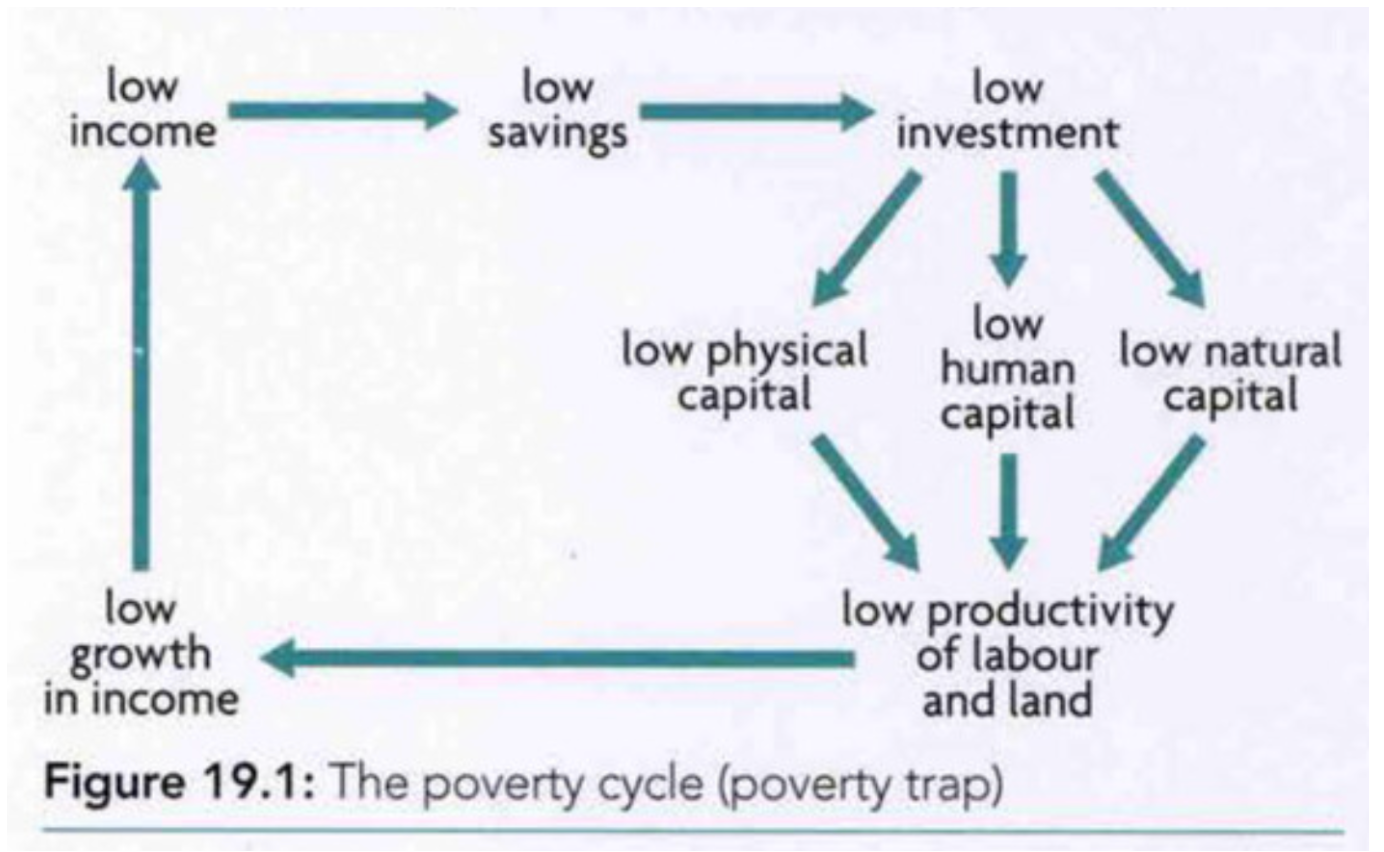
The concept is fundamentally about how poverty is intergenerational - when your parents are trapped in poverty, you're likely to be trapped too, often due to circumstances beyond your control.
The IB Economics course is structured around nine key concepts. While poverty traps connect to many of these, two stand out as particularly relevant:
Poverty traps powerfully illustrate issues of equity. The trap highlights how initial inequalities in resource distribution (whether financial, educational, or social) create path dependencies that perpetuate inequity across generations. Those born into poverty face systematic barriers to escaping it, regardless of their individual effort or talent.
In exam responses, you can use the poverty trap to discuss why market forces alone might not create equitable outcomes, and how specific interventions might be necessary to break cycles of inequality.
Perhaps no model better illustrates the concept of interdependence than the poverty trap. Each element in the cycle depends on others and influences them in turn:
This interdependence explains why single-focus interventions often fail. Addressing just education, just healthcare, or just infrastructure may not be sufficient to break the cycle - the remaining factors can still pull communities back into poverty.
No discussion of poverty traps would be complete without mentioning Oxford economist Paul Collier's influential work, "The Bottom Billion" (2007). Collier identifies four specific traps that keep the poorest countries in the world from developing.
Collier shows how civil wars and political violence create devastating cycles. Conflict destroys infrastructure, depletes resources, and drives away investment - creating conditions for further conflict. Countries that have experienced a civil war have a 22% risk of returning to conflict within five years.
Counterintuitively, abundant natural resources often impede development through what economists call the "resource curse." Resource wealth can generate corruption, undermine governance, reduce incentives for economic diversification, and cause currency appreciation that makes other exports uncompetitive (Dutch disease).
Countries without sea access face higher transportation costs and dependency on their neighbors' infrastructure and policies. When surrounded by unstable or poor neighbors, development becomes even more challenging as regional markets and transit routes remain underdeveloped.
Poor governance and institutional failure create environments where corruption flourishes, property rights remain insecure, and market failures go uncorrected. These conditions deter investment and innovation, undermining economic growth.
Collier's framework provides concrete categories that students can reference in exam responses, allowing for more specific analysis of different development challenges. It also highlights how getting trapped in one of these situations can trigger or reinforce the others, creating compound development challenges.
The UN's Sustainable Development Goal 1 aims to "end poverty in all its forms everywhere" by 2030. Understanding poverty traps is essential to understanding why this goal remains challenging despite decades of international development efforts.
The poverty trap model helps explain why simply increasing aid or temporarily boosting incomes often fails to create sustainable change. The SDG framework itself recognizes this interdependence by setting specific targets related to:
Each of these targets addresses different elements of the poverty trap. In your exam responses, connecting the poverty trap model to relevant SDG targets demonstrates sophisticated understanding of development challenges.
What makes poverty traps such a powerful conceptual tool is their ability to explain why poverty persists despite numerous intervention attempts over decades. The cyclical nature of these traps illuminates three fundamental aspects of persistent poverty:
Poverty traps reveal how different dimensions of deprivation reinforce each other. Poor health reduces educational attainment; limited education constrains income potential; low income prevents health investments. Each factor doesn't just exist alongside others – it actively strengthens them, creating powerful feedback loops that are difficult to break through isolated interventions.
Perhaps most importantly, poverty traps explain why poverty passes from one generation to the next. Children inherit not just their parents' financial circumstances but entire ecosystems of disadvantage. They grow up with poorer nutrition affecting cognitive development, attend under-resourced schools, lack social networks that provide opportunities, and face environmental hazards that wealthier communities don't experience. These disadvantages start before birth and accumulate throughout life.
Poverty traps help us understand why small improvements often don't lead to sustainable progress. Many systems feature "threshold effects" – a certain level of resources, capital, or infrastructure must be reached before positive momentum can begin. Below these thresholds, progress is constantly pulled back into the trap. This explains why modest interventions often show disappointing long-term results.
The poverty trap framework shifts focus from individual shortcomings to structural barriers. Rather than asking "why don't poor people just work harder?", it examines the systems that make advancement nearly impossible regardless of individual effort. This perspective is crucial for designing effective policies that address root causes rather than symptoms.
When applying this to exam questions, you can use the poverty trap to demonstrate how multiple interacting factors create persistent disadvantage, making simplistic or single-focus solutions inadequate for creating sustainable change.
Where the poverty trap truly shines is in helping you construct sophisticated evaluations of development policies and issues. Here's how to leverage this model in your exam responses:
When discussing development strategies, use the poverty trap to assess whether an intervention addresses:
Example: Microfinance initiatives provide credit to those excluded from traditional banking. You could evaluate this using the poverty trap:
The poverty trap helps construct balanced arguments about different approaches to development:
Market-based approaches might focus on creating economic opportunities and removing barriers to investment, targeting the "low investment" and "low productivity" links.
Interventionist approaches might focus on direct provision of education, healthcare, or infrastructure to break multiple links simultaneously.
Both have merits and limitations when viewed through the poverty trap lens.
Rather than simplistic "this policy is best" conclusions, the poverty trap model encourages nuanced thinking:
The poverty trap model offers IBDP Economics students a versatile framework that can be applied to numerous development-related questions. By mastering this model, you gain:
While there are certainly other important diagrams in the IB Economics course, few offer the analytical versatility of the poverty trap when tackling development questions. Invest time in understanding this model deeply, and it will serve you well across various exam contexts.
made with the help of AI
 Anumeha Yadav in Naujheel, Uttar Pradesh