Labour Day, celebrated on different dates around the world, honors the contributions and achievements of workers to the strength, prosperity, and well-being of countries. For IBDP Economics students, Labour Day offers an excellent opportunity to explore the role of labour as a factor of production and the complex evolution of labour relations throughout economic history across various economic systems and cultural contexts.
Historical Context of Labour Day
The origins of Labour Day can be traced to the Industrial Revolution in the late 1800s, when workers often faced harsh conditions with lengthy workdays and unsafe environments. As manufacturing increasingly supplanted agriculture as the primary source of employment, labour movements emerged globally, organising strikes and rallies to protest poor working conditions and advocate for better hours and pay.
While the United States and Canada celebrate Labour Day in September, many countries observe International Workers' Day on May 1st (May Day), which similarly commemorates historic labour struggles and achievements. The date for May Day was chosen to commemorate the Haymarket affair in Chicago, but the holiday has been adapted to local contexts worldwide.
Different regions developed distinct labour movements reflecting their unique economic and political circumstances. In Europe, labour movements often had stronger connections to socialist political parties, while in Asia, labour organising frequently intertwined with anti-colonial and independence movements.
Labour Day in India
India celebrates Labour Day (also called May Day or International Workers' Day) on May 1st. The first Labour Day in India was celebrated in 1923 in Chennai (then Madras) by the Labour Kisan Party of Hindustan. This celebration was particularly significant given India's colonial context at the time.
The Indian labour movement has distinctive characteristics reflecting the country's economic development path:
Colonial legacy: During British rule, labour movements in India were intertwined with the independence struggle. labour organisations not only fought for worker rights but also for national liberation.
Formal and informal sectors: India's economy features a large informal sector alongside formal employment. This dual structure creates unique challenges for labour organization and protection.
Agricultural labour: Unlike many Western countries where industrial workers formed the core of early labour movements, India's labour concerns have always included agricultural workers and their specific challenges.
Recent reforms: India has undergone significant labour reforms in recent years, consolidating numerous labour laws into four main codes covering wages, social security, occupational safety, and industrial relations.
The economic significance of Labour Day in India highlights the ongoing tension between promoting economic growth through investment-friendly policies and ensuring adequate protections and living standards for workers across diverse economic sectors.
The Triumph of Labour Statue, Chennai, India
The “Triumph of Labour” (also known as “Labour Statue” or “Uzhaippin Vetri”) is an iconic sculpture located at Marina Beach in Chennai, Tamil Nadu. Created by sculptor Debi Prasad Roy Chowdhury, it was unveiled on January 25, 1959, as the first labour statue in India after independence.
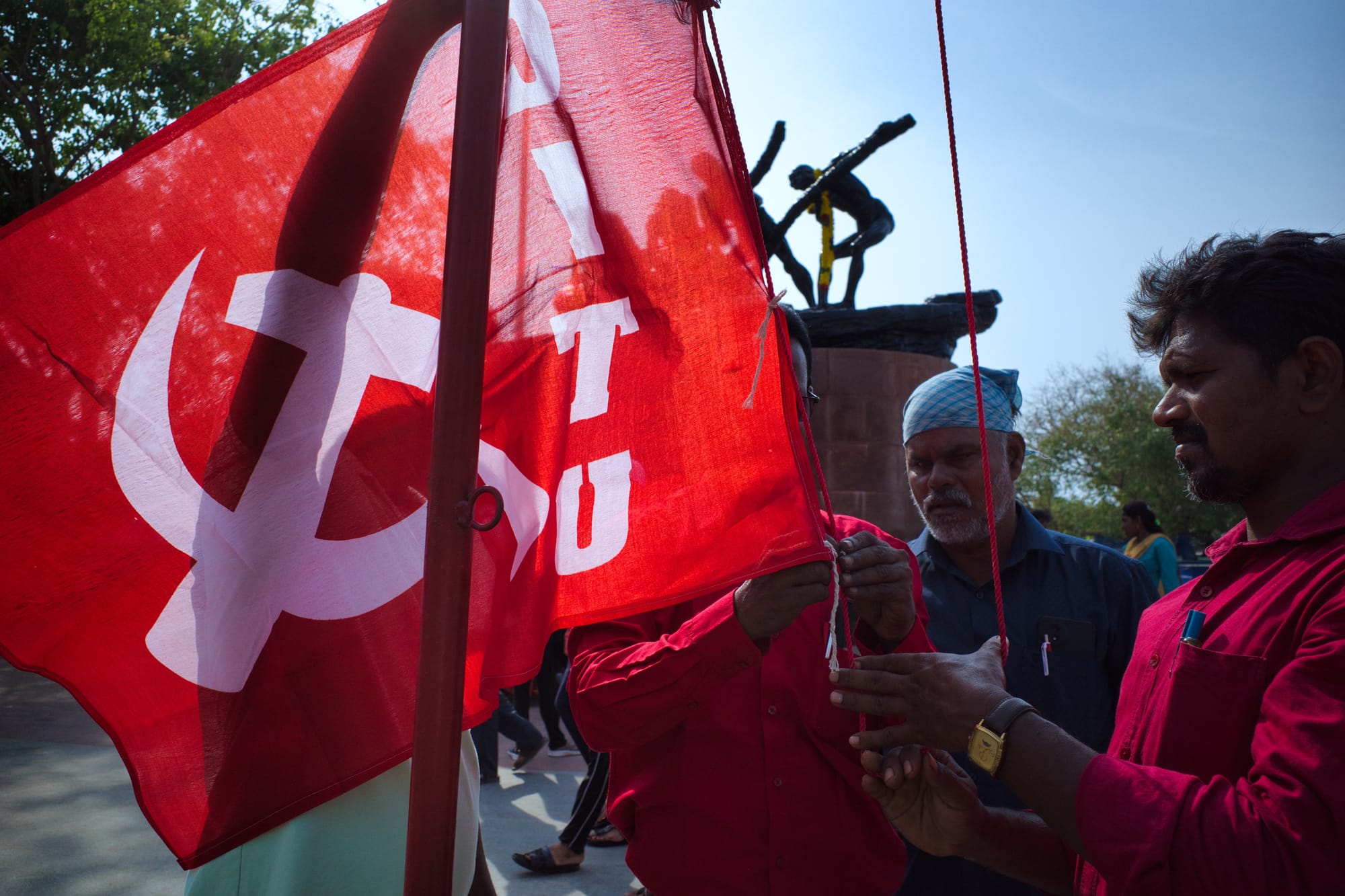
1st May 2025 at The Triumph of Labour, Chennai. (Kelly)
The bronze sculpture depicts four men working together to move a large rock, symbolising the dignity and collective strength of labor. The statue was inspired by the Labor Movement in India and commemorates the hard work of the labouring classes who built modern India. It has become a symbol of Chennai and is particularly significant during May Day (Labour Day) celebrations when workers and unions gather around it.
The statue represents not just physical labour but the triumph of human persistence and collaboration in overcoming obstacles—a powerful metaphor for the labour movement’s struggle for rights and recognition.
Labour Markets at the Crossroads: The AI Revolution
As we commemorate Labour Day's rich history, we find ourselves at a pivotal moment in the evolution of work. Artificial intelligence represents perhaps the most transformative force reshaping labour markets since the Industrial Revolution that first inspired labour movements. This technological revolution differs fundamentally from previous ones—while earlier automation primarily replaced physical labour and routine tasks, AI increasingly demonstrates capabilities in cognitive domains once considered uniquely human.
The economic implications are profound and multifaceted. Recent studies suggest that approximately 60-70% of current jobs will be at least partially transformed by AI, with significant portions of tasks becoming automatable across occupations ranging from lorry drivers to radiologists, customer service representatives to legal assistants. Unlike previous technological transitions, AI's impact cuts across blue-collar and white-collar work alike, affecting workers at all education levels.
From an economic perspective, this transition raises several critical questions that connect directly to the IBDP Economics curriculum:
Productivity and inequality: While AI promises significant productivity gains—potentially adding trillions to global GDP—economic theory suggests that the distribution of these gains remains an open question. If productivity benefits accrue primarily to capital owners rather than workers, inequality could widen substantially, exacerbating trends already observed in many economies.
Labour market polarisation: Early evidence suggests AI may accelerate labour market polarisation, with growth in both high-skilled jobs that complement AI and low-wage service jobs that remain difficult to automate, while continuing to hollow out middle-skill occupations. This connects directly to concepts of structural unemployment and income distribution.
Skills transitions and human capital: The pace of AI adoption may outstrip workers' ability to reskill, creating significant frictional unemployment and requiring new approaches to education and training. Human capital development becomes increasingly crucial as a policy response.
Market power considerations: The economics of AI tend toward concentration, with significant advantages accruing to companies with the most data and computing resources. This raises concerns about increased monopsony power in labour markets, potentially weakening workers' bargaining position.
For economics students, this transformation offers a real-time case study in how technological change affects labour markets, challenging both neoclassical assumptions of frictionless adjustment and raising profound questions about the future relationship between labour and capital. The potential for both enormous wealth creation and significant displacement creates complex equity considerations that echo the very tensions that gave birth to Labour Day itself.
As with previous industrial transitions, society's response will likely determine whether AI's benefits are broadly shared. Policy experiments are already emerging globally—from universal basic income trials to ambitious public reskilling programmes and new forms of collective bargaining for digital workers. These developments represent the continuation of the fundamental economic questions that labour movements have grappled with throughout history: How should the gains from increased productivity be distributed? What constitutes fair compensation in a changing economy? How can technological progress advance human welfare rather than undermining it?
By understanding these continuities between historical labour movements and contemporary challenges, economics students gain valuable perspective on how economic principles play out in periods of technological disruption—and potentially, how policy and institutional innovations might shape more equitable outcomes.
IBDP Economics Curriculum Connections
Unit 1: Introduction to Economics
Labour as a Factor of production: labour is one of the four factors of production alongside land, capital, and entrepreneurship. The holiday reminds us of labour's essential role in production and wealth creation.
Economic systems: Different economic systems offer distinct approaches to labour rights and organisation. Socialist economies like Cuba prioritise full employment, while market economies like Singapore focus on labour market flexibility. Mixed economies like Germany have developed distinctive forms of worker participation through works councils.
Economic thought: The labour movement embodies competing economic perspectives. Classical economists viewed labour markets as self-regulating while Marx emphasized labour exploitation under capitalism. Post-colonial economists have highlighted how labour relations in developing countries have been shaped by historical economic dependencies.
Scarcity and choice: The birth of labour movements highlights the scarcity of good working conditions and fair wages, forcing societies to make choices about how to balance economic efficiency with worker protection.
Unit 2: Microeconomics
Labour markets: labour markets involve real people whose well-being is affected by market outcomes. These markets function differently across countries—from the flexible labour markets of the United Kingdom to the more regulated approaches in France.
Market power: labour unions emerged partly in response to monopsony power (when employers have significant market power as buyers of labour). Union strength varies dramatically worldwide, from high union density in the Nordic countries to more limited organisation in many developing nations.
Market failure: Poor working conditions, unsafe environments, and extreme inequality in bargaining power represent potential market failures that prompted the creation of unions and labour regulations.
Government intervention: Labour Day's history illustrates various forms of government intervention in labour markets, including minimum wage laws, workplace safety regulations, and legal protections for collective bargaining.
Equity vs Efficiency: The labour movement embodies the economic tension between efficiency (maximising output) and equity (ensuring fair distribution). This tradeoff remains central to current debates about labour policies in both developed and developing economies.
Unit 3: Macroeconomics
Employment objectives: Low unemployment is a key macroeconomic goal for most governments. However, different countries prioritise employment stability differently—Japan has historically emphasised lifetime employment, while the United States has favoured labour market flexibility.
Measurement of labour markets: Understanding how unemployment is measured and categorised (cyclical, structural, frictional) provides insight into labour market health beyond simple employment statistics. Many developing countries face significant underemployment rather than official unemployment.
Economic growth: labour productivity is crucial for long-term economic growth. Countries at different stages of development face distinct productivity challenges, from basic skill development in less developed economies to advanced technological adaptation in industrialised nations.
Income distribution: The distribution of income between labour and capital affects aggregate demand and economic stability. This ratio has changed significantly in many countries over recent decades, with labour's share of national income declining in both developed and developing economies.
Unit 4: The Global Economy
International labour standards: Organisations like the International Labour Organisation establish global standards for working conditions, highlighting the international dimension of labour issues. However, enforcement and adoption vary significantly across countries.
Migration and labour mobility: Global labour movements reflect economic opportunities and working conditions across countries. Migration patterns include South-to-North flows (Mexico to US), regional movements (within the EU or ASEAN), and increasing South-to-South migration.
Globalisation's impact: Outsourcing, offshoring, and global supply chains have transformed labour relations. Workers across the global supply chain—from garment workers in Bangladesh to electronics assemblers in Malaysia to retail workers in Brazil—experience different effects from economic integration.
Comparative advantage and labour: Trade theories often assume labour mobility within countries but not between them. labour conditions affect the benefits of trade, raising questions about whether low labour standards constitute an unfair trade advantage.
Economic development: labour conditions often reflect a country's stage of development. The evolution of South Korea or Taiwan from low-wage manufacturing to high-skill industries offers insights for development strategies elsewhere.
Case Studies to Explore
Workplace Safety Evolution: The 2013 Rana Plaza collapse in Bangladesh, which killed over 1,100 garment workers, sparked global debate about working conditions in global supply chains. You can analyse the economic pressures and responses that influence workplace safety regulations.
Automation and Technology: From industrial looms to modern AI, technological change has continually reshaped labour markets worldwide. The effects vary by region, with different implications for advanced economies versus countries still industrialising.
The Gig Economy: The rise of platform-based work through companies like Grab (Southeast Asia), Ola (India), and Rappi (Latin America) represents a fundamental shift in employment relationships globally. You can consider how this affects labour rights, income security, and government policy.
Minimum Wage Policies: Countries approach minimum wages differently—from Singapore's sector-specific approach to France's higher general minimum. You can examine the empirical evidence around various minimum wage policies and their effects.
Diversity and Inclusion: labour markets often feature persistent wage gaps based on gender, race, and other characteristics. These patterns manifest differently across cultural contexts but remain a widespread economic challenge.
Connecting to Key Concepts
Equity: Labour Day emerged from concerns about equitable treatment of workers, highlighting the distinction between equality and equity in economic contexts across diverse societies.
Intervention: The holiday's history illustrates both market failures that prompted intervention and debates about the appropriate scope of government action in labour markets. These debates take distinct forms in different economic systems.
Economic well-being: Labour Day reminds us that economic well-being involves more than income alone; it includes working conditions, job security, and work-life balance. These aspects are prioritised differently across cultures.
Sustainability: labour movements have increasingly connected worker welfare with environmental sustainability, recognising that both are necessary for long-term economic health. The concept of "just transition" for workers in carbon-intensive industries reflects this connection.
Interdependence: The evolution of labour relations demonstrates the interdependence of workers, employers, and consumers in creating economic outcomes. Global supply chains have extended this interdependence across national boundaries.
Conclusion
Labour Day offers more than a holiday; it provides a meaningful connection to economic history and concepts central to the IBDP Economics curriculum. By exploring the economic dimensions of labour movements across diverse global contexts, you can better understand the complex relationships between markets, government policies, and human welfare that remain central to economic analysis today.
As work continues to evolve in the digital age and global economy, the fundamental questions raised by labour movements remain relevant: How do we balance efficiency with equity? What constitutes fair compensation and treatment? How should the gains from productivity be distributed? These questions connect Labour Day's historical significance to the economic challenges and opportunities that you will navigate in their future careers, regardless of where you live and work.
Content developed by Matt with AI collaboration.
In the arts
Sebastião Salgado's "Workers"
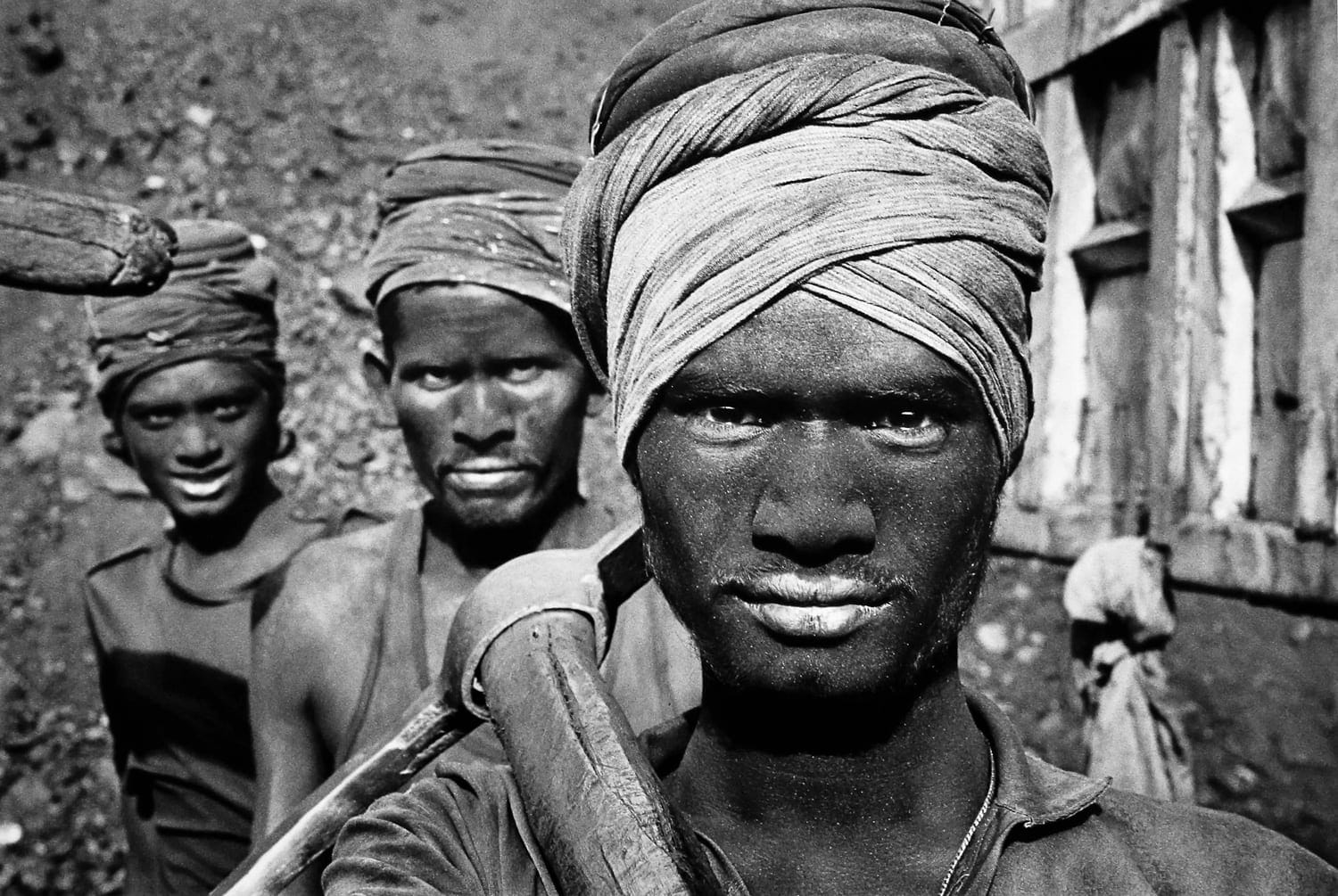
Another form of commemorating labour exists not in bronze or stone but through the lens of Brazilian photographer Sebastião Salgado, one of my personal favorite documentary photographers. His monumental project "Workers: An Archaeology of the Industrial Age" (1993) stands as one of the most comprehensive visual documents of global labour in the late 20th century. What makes Salgado's perspective particularly fascinating for us is his personal professional journey—before becoming a photographer at age 29, he earned a PhD in economics from the University of Paris and worked for the International Coffee Organisation, giving him a unique analytical framework for understanding the global economic systems he later documented visually. Over seven years, Salgado traveled to 26 countries, capturing images of manual labourers in industries facing extinction due to technological change and globalisation. His stark black and white photographs document steelworkers in Ukraine, ship-breakers in Bangladesh, sulfur miners in Indonesia, and gold miners in Brazil's Serra Pelada mine, among many others.
The Serra Pelada images, showing thousands of mud-covered workers climbing rickety ladders in a massive open pit, have become particularly iconic representations of human labour. Unlike physical monuments that often idealize or abstract labour, Salgado's work presents the raw physical reality and dignity of workers' lives across diverse cultural contexts. His photographs function as a different kind of memorial—a visual archive preserving forms of labour that were disappearing even as he documented them. For economics students, Salgado's work provides powerful visual evidence of how economic systems materially affect human bodies and communities, making abstract economic concepts viscerally concrete. His images illustrate structural economic transitions, global inequalities, and the human consequences of changing modes of production, offering a compelling resource for understanding labour as both an economic factor and a lived human experience.
Charlie Chaplin's "Modern Times"
No discussion of artistic representations of labour would be complete without mentioning Charlie Chaplin's masterpiece "Modern Times" (1936), one of cinema's most powerful commentaries on industrial work. Released during the Great Depression, this silent film follows Chaplin's iconic Little Tramp character as he struggles with the dehumanising effects of assembly line work. The film's most memorable scenes—Chaplin frantically tightening bolts until he suffers a nervous breakdown, being fed by an automatic "feeding machine," or literally being pulled through the cogs of giant machinery—have become defining visual metaphors for the human costs of industrialisation and scientific management. Though punctuated with Chaplin's characteristic physical comedy, "Modern Times" offers a serious critique of how mass production techniques like Fordism and Taylorism reduced workers to mere extensions of their machines, sacrificing human dignity for efficiency.
What makes the film particularly relevant for economics students is its exploration of several key concepts in the IBDP curriculum: the tension between technological progress and human welfare, the social consequences of unemployment, and the complex relationship between efficiency and equity. Chaplin himself said he was inspired by a conversation with Mahatma Gandhi about how "machinery with only its consideration of profit is the cause of much unhappiness." Nearly a century later, as automation and artificial intelligence transform contemporary workplaces, "Modern Times" remains startlingly relevant, inviting students to consider continuities and changes in how economic systems organize human labour. The film demonstrates how artistic expression can offer powerful economic insights that complement more formal analytical approaches, making it an excellent resource for understanding the lived experience of economic theories and policies.
Follow up quick research challenge
Go online and find images for each of the following
Which art is most striking you? Which of the histories below inspires you to learn more?
Other Notable Labor Monuments Around the World:
Monument to the Workers’ Party of Korea, Pyongyang, North Korea While politically controversial, this massive monument completed in 1995 is one of the most visually striking labor monuments in East Asia. Standing 50 meters tall, it features three enormous hands holding a hammer (representing industrial workers), a sickle (representing agricultural workers), and a writing brush (representing intellectuals). The monument exemplifies how labor iconography has been incorporated into state ideology in different contexts. Despite its political associations, the monument is artistically significant for its dramatic scale and its representation of different types of labour—manual, agricultural, and intellectual—as equally valuable to society.
Workers’ Monument, Maputo, Mozambique Located in the center of Maputo, Mozambique’s capital, this striking monument honours the country’s workers who struggled both against colonial exploitation and for better working conditions. Created after Mozambique gained independence from Portugal in 1975, the socialist-realist style sculpture depicts strong laborers with raised fists, symbolizing resistance and solidarity. The monument reflects Mozambique’s post-independence Marxist-Leninist orientation and the central role that workers and peasants played in the national liberation struggle led by FRELIMO (Mozambique Liberation Front). It stands as a testament to how labour movements in Africa were often intertwined with anti-colonial and independence struggles, representing not just workplace issues but national liberation and dignity.
Haymarket Martyrs’ Monument, Chicago, USA Located in Forest Park near Chicago, this monument commemorates the Haymarket affair of 1886, a pivotal event in labour history. After a peaceful rally in support of striking workers turned violent, several police officers and protesters were killed. Eight labour activists were controversially convicted, and four were executed. The monument features a bronze sculpture of a figure representing justice standing over a fallen worker. Dedicated in 1893, it became a designated National Historic Landmark in 1997. The Haymarket incident influenced the establishment of International Workers’ Day on May 1st, making this monument significant to labor movements worldwide.
Monument to the Revolution, Mexico City, Mexico This massive arch in Mexico City honors the Mexican Revolution (1910-1920), which had significant labour components. Completed in 1938, the monument contains the remains of revolutionary heroes including Francisco Madero, Venustiano Carranza, Plutarco Elías Calles, and labor leader Francisco “Pancho” Villa. The monument’s Art Deco design features four pillars with sculptures representing the revolution’s ideals: Independence, Reform Laws, Agrarian Laws, and Labour Laws. The Labour Laws sculpture explicitly honors the struggle for workers’ rights that was central to the revolution. The monument remains a powerful symbol of social and economic justice in Mexico.
The Worker and Kolkhoz Woman, Moscow, Russia This iconic 24.5-meter stainless steel sculpture was created by Vera Mukhina for the 1937 World’s Fair in Paris. It depicts a male worker and female collective farm worker (kolkhoz woman) holding aloft a hammer and sickle. The monument embodies the Soviet idealisation of industrial and agricultural labour. After the World’s Fair, the statue was installed in Moscow, where it became one of the most recognizable symbols of Soviet art and ideology. While the political context has changed dramatically since its creation, the monument remains significant for its artistic representation of labour and its place in global cultural history.
Monumento al Trabajo (Monument to Work), Buenos Aires, Argentina Created by Argentine sculptor Rogelio Yrurtia and inaugurated in 1927, this monumental sculpture consists of multiple bronze figures depicting labourers engaged in physical work. The composition shows workers pulling heavy stones, symbolizing the burden and dignity of labor. The monument captures the strain of physical exertion while conveying the determination and solidarity of workers. Located in the Parque Patricios neighborhood of Buenos Aires, it reflects Argentina’s strong labour tradition and the significant role of unions in the country’s political and economic history.
The Solidarity Monument, Gdańsk, Poland This striking 42-meter tall monument near the Gdańsk Shipyard commemorates the workers killed during anti-government protests in 1970. It later became associated with the Solidarity movement of the 1980s, which began in these shipyards and ultimately contributed to the fall of communist rule in Poland. Designed by Polish sculptor Robert Pepliński and unveiled in 1980, the monument features three crosses topped with anchors, symbolising hope and the maritime industry. The Solidarity movement represented a powerful alliance between workers and intellectuals, and this monument stands as a reminder of labour’s role in political transformation and the fight for democratic rights.
Each of these monuments tells a unique story about labor’s significance in different cultural and political contexts. Together, they illustrate how the themes of worker dignity, collective action, and the struggle for rights have resonated across diverse societies—making them excellent teaching tools for connecting economic concepts to real-world historical experiences.