From BMW to Bureaucracy: How Toilet Access Exposes Inequality and Poverty
Before reading further, take 30 seconds to count: * How many toilets/bathrooms are in your house? * How many people live
Before reading further, take 30 seconds to count: * How many toilets/bathrooms are in your house? * How many people live

Ask any IBDP Economics teacher, and they'll tell you that mastering supply and demand curves and the AD/
In the IB Economics course, the difference between a good essay and an excellent one often lies not in what

If you're studying IB Economics, you've undoubtedly encountered Adam Smith and his famous "invisible hand" metaphor. Often portrayed as the founding father of free-market economics, Smith's name is typically associated with laissez-faire capitalism and self-interest as an economic driver. But reducing Smith's rich intellectual legacy to just these concepts does a disservice to both Smith and economics students.
In this post, we'll explore how Adam Smith's work provides deeper insights into many aspects of the IBDP Economics curriculum, and why a more complete understanding of his ideas can enrich your economic thinking.
Here's a surprising fact: in his monumental work "The Wealth of Nations" (1776), Smith mentioned the "invisible hand" exactly once. Yes, just once in over 900 pages! Yet this metaphor has come to define his entire economic philosophy in popular discourse.
While Adam Smith is often celebrated as the founder of modern economics, there's considerable debate about whether this title is entirely deserved. Many of the ideas attributed to Smith had precursors in earlier thinkers:
The Scholastics of the School of Salamanca (15th-17th centuries) developed sophisticated theories of value, price, and money. Scholars like Luis de Molina and Francisco de Vitoria explored concepts of supply and demand and utility before Smith was born.
Ibn Khaldun (1332-1406), the Arab philosopher and historian, wrote about division of labor, the importance of free markets, and the negative effects of government intervention centuries before Smith.
François Quesnay and other Physiocrats in France developed the concept of circular flow of income and the idea that economies work best when allowed to function with minimal interference—ideas Smith studied during his time in France before writing "The Wealth of Nations."
David Hume, Smith's close friend, wrote extensively on economics before Smith, particularly on monetary theory and international trade, providing foundations for Smith's later work.
Richard Cantillon's "Essay on the Nature of Trade in General" (1730s) contained theories of entrepreneurship, market equilibrium, and price formation that predated Smith's similar ideas by decades.
Smith's genius was not necessarily in originating these concepts, but in synthesizing existing ideas into a coherent system, supporting them with compelling examples, and presenting them in an accessible manner. For IBDP Economics students, this highlights the evolutionary nature of economic thought (Unit 1.2) and reminds us that even groundbreaking work builds on the foundations laid by others.
The famous quote appears in Book IV when Smith writes:
"By preferring the support of domestic to that of foreign industry, he intends only his own security; and by directing that industry in such a manner as its produce may be of the greatest value, he intends only his own gain, and he is in this, as in many other cases, led by an invisible hand to promote an end which was no part of his intention."
Smith was explaining how individuals pursuing their self-interest can inadvertently promote society's economic interests. This idea connects directly to the IBDP Economics Unit 2 section on competitive market equilibrium, where you learn how the price mechanism efficiently allocates resources without central direction.
Before writing "The Wealth of Nations," Smith published "The Theory of Moral Sentiments" (1759), which explores human morality and social psychology. In this earlier work, Smith introduces the concept of "sympathy" (what we might now call empathy) as the foundation of moral judgment.
Smith wrote:
"How selfish soever man may be supposed, there are evidently some principles in his nature, which interest him in the fortune of others, and render their happiness necessary to him, though he derives nothing from it except the pleasure of seeing it."
This perspective adds crucial context to his economic theories. Smith never advocated for pure selfishness without moral constraints. Rather, he believed that self-interest operates within a framework of social norms and moral considerations.
For IBDP Economics students, this connects to topics like:
Contrary to his portrayal as an anti-government economist, Smith actually worked as a customs commissioner for the government! He held this position for nearly a decade until his death, enforcing tariffs and combating smuggling.
In "The Wealth of Nations," Smith outlined several legitimate roles for government:
Smith was critical of many government interventions of his time, particularly those that created monopolies or protected special interests. However, he wasn't opposed to all government activity in the economy.
This nuanced view aligns with IBDP Economics Unit 2.7 on the role of government in microeconomics, which examines when government intervention may be necessary or beneficial. It also connects to macroeconomic policy debates in Unit 3 regarding the proper extent of government action.
Smith's analysis of division of labor in pin factories is one of the most famous passages in "The Wealth of Nations." He observed how breaking down production into specialized tasks dramatically increased productivity. This concept is foundational to understanding:
Smith wrote that division of labor is "the greatest improvement in the productive powers of labour," but he also worried about its potential negative effects on workers, noting that when a person's work is confined to a few simple operations, they may become "as stupid and ignorant as it is possible for a human creature to become."
This concern relates directly to discussions of equity, sustainability, and human development in Unit 4 of the IBDP curriculum.

Smith's masterpiece "The Wealth of Nations" is divided into five books, each addressing different aspects of economics. Here's what you'll find in each:
Book I: Production, Wages, Profits, and Value This book introduces the division of labor concept (the famous pin factory example), explains how wages and profits are determined, and develops a labor theory of value. Most relevant for: Unit 2 microeconomics concepts like productivity, efficiency, and price determination.
Book II: Capital Accumulation Smith explores how capital is accumulated and used productively in an economy. He distinguishes between productive and unproductive labor and examines money, banking, and interest rates. Most relevant for: Unit 2 (factors of production) and Unit 3 (macroeconomic theories about growth).
Book III: Economic History The shortest book examines how economies developed historically from feudalism to commercial society. Most relevant for: Unit 4 topics on economic development and understanding the historical context of economic systems.
Book IV: Critique of Economic Policies This book (where the "invisible hand" is mentioned) critiques mercantilism and other economic theories, making the case for free trade. Most relevant for: Unit 4 sections on international trade and trade protection. It's highly relevant to modern debates about protectionism versus free trade.
Book V: Government Revenue and Expenditure Smith discusses the proper role of government, public services, and taxation principles. Most relevant for: Unit 2.7 (role of government in microeconomics) and Unit 3.6 (fiscal policy). This book has significant relevance to modern public finance and tax policy debates.
For IBDP Economics students, Books I, IV, and V contain the most immediately applicable material to your syllabus. However, the entire work shows how a comprehensive economic analysis integrates microeconomics, macroeconomics, and global economic issues—just as your IB course does.
The IBDP Economics course is organised around nine key concepts: scarcity, choice, efficiency, equity, economic well-being, sustainability, change, interdependence, and intervention. Smith's work provides rich insights into each of these:
For IBDP Economics students, Adam Smith offers more than just a historical footnote or simplistic advocacy of free markets. His careful observations, moral foundations, and systematic thinking demonstrate what good economic analysis looks like.
Smith combined theoretical reasoning with extensive real-world examples, considering both efficiency and equity. He understood the power of markets while recognizing their limitations. And he always situated economic questions within broader social and moral contexts.
As you work through your economics course, consider returning to Smith's original texts. You might be surprised by how relevant his insights remain, and how much deeper his thinking goes beyond the simplified "invisible hand" that appears in most textbooks.
Content developed by Matt with AI collaboration.
 0
0
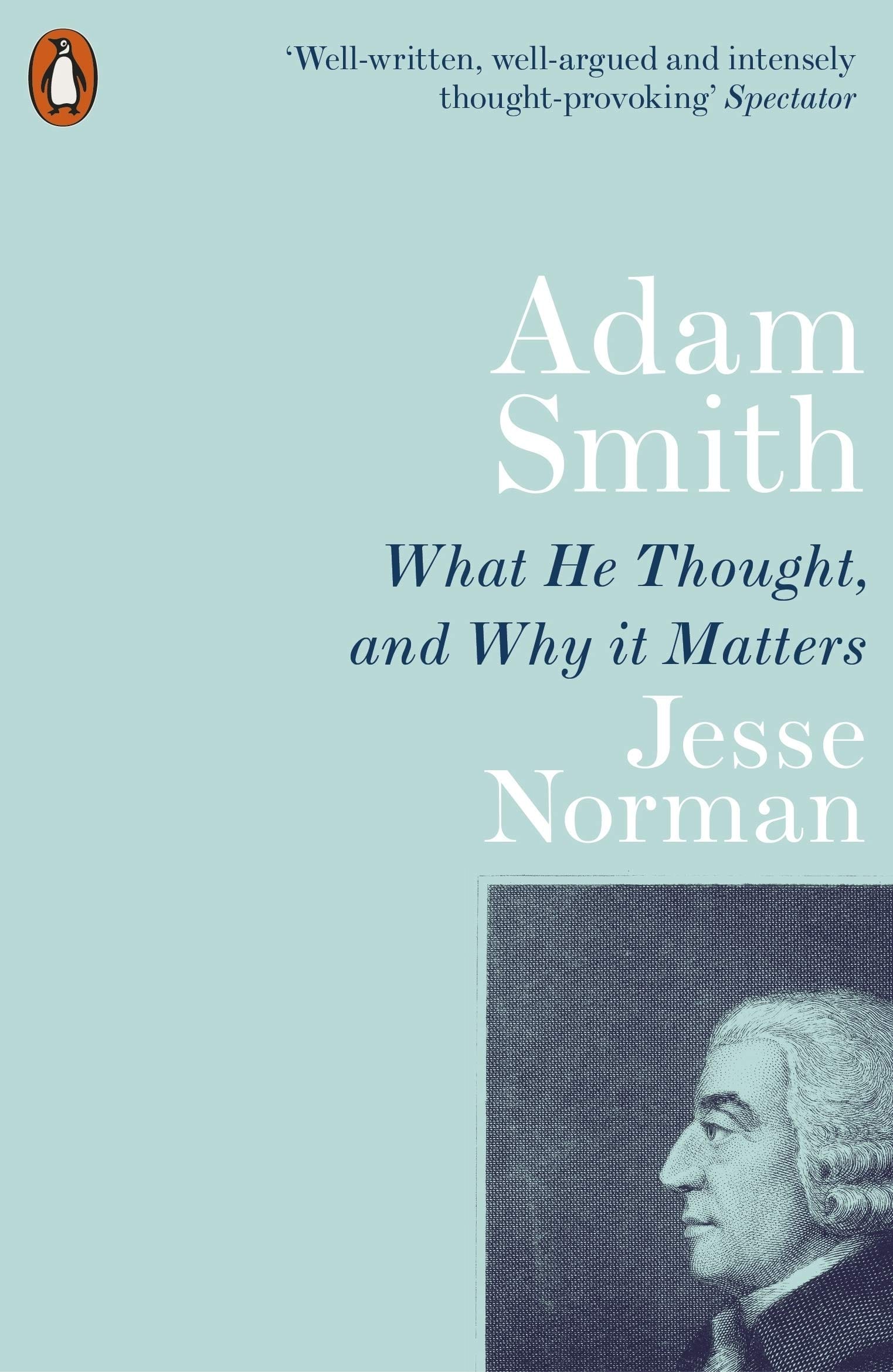
Adam Smith: What He Thought and Why It Matters by Jesse Norman. Presents a fresh examination of Smith as both a moral philosopher and political economist, challenging simplistic characterizations of his views on markets and government. Norman, who is both a Conservative MP and a philosopher, skillfully contextualizes Smith's ideas within their historical setting while demonstrating their remarkable relevance to contemporary issues like inequality, corporate power, and the proper boundaries between state and market.
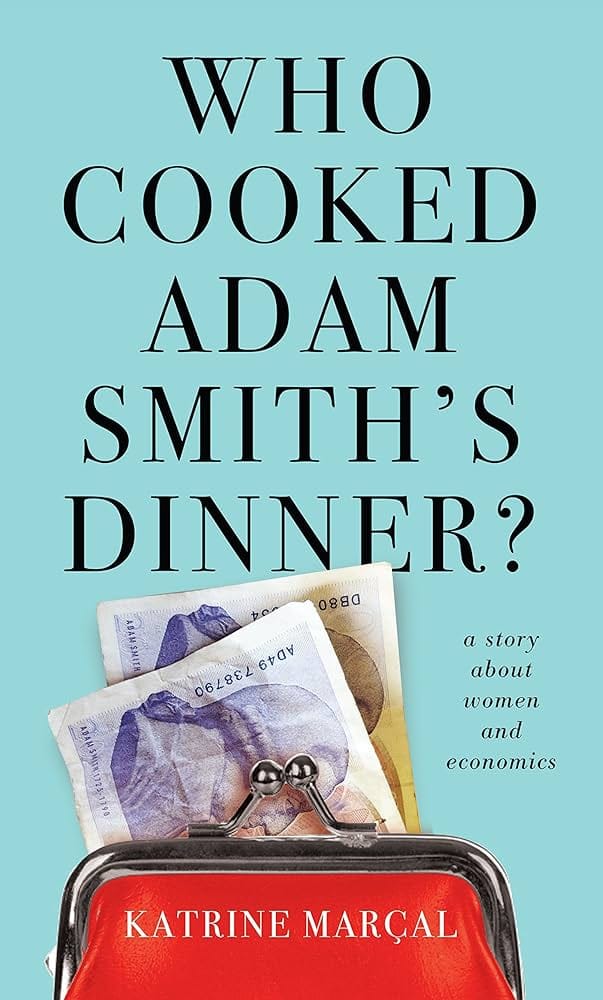
Who Cooked Adam Smith's Dinner? by Katrine Kielos. This thought-provoking book examines how economic theory has historically ignored the unpaid work predominantly performed by women, pointing out that while Adam Smith wrote about self-interest driving markets, his mother provided him with care and meals without compensation. Kielos challenges mainstream economics' narrow focus on market transactions by highlighting how our economic system depends on crucial unpaid labor and care work that remains largely invisible in traditional economic analysis.
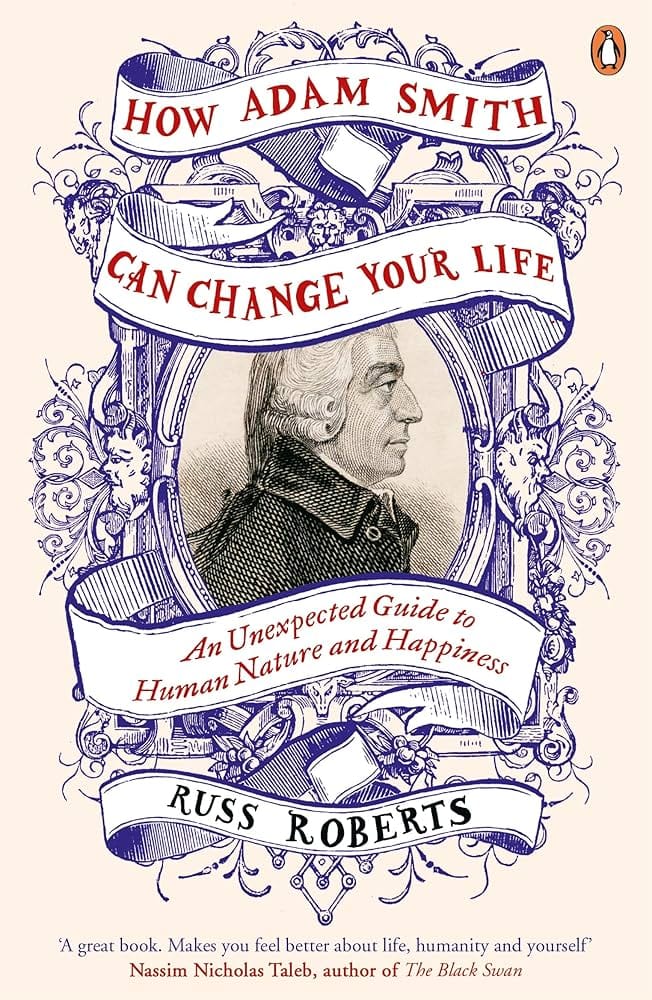
How Adam Smith Can Change Your Life by Russ Roberts. Explores Smith's lesser-known work "The Theory of Moral Sentiments," showing how Smith's insights on human behavior, happiness, and virtue can help readers lead more meaningful lives. Roberts, an economist and podcast host, translates Smith's 18th-century moral philosophy into practical wisdom for modern readers, revealing a side of Smith that's focused more on compassion and self-improvement than markets and capitalism.